4x5 Tachihara
A 4x5 that folds up into a compact package.

4x5 Tachihara on a Ries J250 tripod head (Color photos of the camera were made with a Nikon F, 55mm f/3.5 Micro-Nikkor-P.C, and Portra 400.)
Good for long-distance travel and hiking
The Tachihara is a wooden 4x5 camera made in Tokyo. It is unusually light and compact. The camera, one lens, a half-dozen film holders, a wooden tripod, and the rest of a 4x5 view camera kit is portable enough for a trip involving air travel and hiking along the trail.

Using this camera in the field Angkor region, Cambodia, 2001 The camera is on a Ries tripod and the camera bag is under the tripod. Photo data not recorded.

The Bayon Angkor region, Cambodia Negative: 4x5 Tachihara, 150mm f/5.6 Caltar II-N, Plus-X, 2001. Platinum-palladium print from original camera negative, 2025.
Design features
In addition to being light, small, and beautifully finished, the Tachihara has:
Linhof lens board compatibility. This is a standard type of lens board, readily available.
Good movement capability. Front: rise, fall, tilt, swing. Rear: tilt and swing. Pretty complete. Movement ranges are not as extreme as with a monorail but are fully adequate for my use.
A non-interchangeable bellows. However, the bellows is high quality and compresses very thin, so that a 65mm lens can be used without a recessed lens board.
13” maximum bellows extension.

Devata Angkor region, Cambodia Negative: 4x5 Tachihara, 150mm f/5.6 Caltar II-N, Plus-X, 2001. Cyanotype print on Strathmore 300 watercolor paper, from the original camera negative, 2023. Several hours of water soaking reduced the blue tint.

4x5 Tachihara.
Other 4x5 wooden field cameras
There were other Japanese wooden field cameras: Wista, Ikeda, Nagaoka, and Hasemi are examples. They’re similar to the Tachihara but with detail design differences.
These cameras were popular in the mid- to late-20th and very early 21st centuries but by 2010 or so they were out of production. Today, makers in other countries continue to serve this market but the classic Japanese models are only available used.

4x5 Tachihara.

Goblin Café & The Vodka Bar Gaien Higashi-dori, Roppongi, Tokyo 4x5 Tachihara, 90mm f/8 Super-Angulon, Tri-X, 2004.

Rooftop deck of a Homat apartment building off Gaien Higashi-dori, Roppongi, Tokyo Negative: 4x5 Tachihara, 150mm f/5.6 Caltar II-N, FP4+, mid 2000s. Cyanotype print on Strathmore 300 watercolor paper, from the original camera negative, 2023.
Maintenance and repair
I purchased this camera at the Adorama shop in New York in the late 1990s. It’s one of the very few cameras I ever bought new. It has not required maintenance and it looks and works like brand-new despite extensive (but careful) use.

4x5 Tachihara at full extension. On an older model Bogen/Manfrotto 3047 tripod head.
References / further reading
Adams, Ansel. The Camera. Boston: Little, Brown, 1980. A Japanese 4x5 wood field camera is on p. 32.
Berger, B. 1979 (May). Handbuilt cameras: The craftsman’s art. Popular Mechanics.
A two-page review of the 4x5 Tachihara, Nagaoka, and Ikeda wooden field cameras. They are described as quite similar; with the Tachihara slightly heavier than the other two. (Nagaoka and Ideda: 2.6 lb; Tachihara 3.3 lb) https://utahfilmphotography.com/2024/04/03/the-tachihara-4x5-field-camera/
Jacques, C., in collaboration with R. Dumont. 1990. Angkor. Cologne: Konemann.
Jacques, C. and M. Freeman. Angkor: Cities and Temples. Thailand (city not stated): River Books.
Jessup, H. I. 2004. Art and Architecture of Cambodia. London: Thames & Hudson, World of Art.
Marah, C. 1978 (Jan.) Far East Journal: Something old, something new. PhotoGraphic.
A one-page article with information from an interview with Michio Tachihara, the manager of the company and son of the founder. https://utahfilmphotography.com/2024/04/03/the-tachihara-4x5-field-camera/
Myrdal, J. and G. Kessle. 1970. Angkor: An Essay on Art and Imperialism. New York: Random House (Vintage Books ed., 1971)
Petrochenko, M. 2017. Focusing on the Angkor Temples: The Guidebook, 4th ed. Bangkok: Amarin Printing and Publishing.
Rawson, P. 1967. The Art of Southeast Asia. London: Thames & Hudson, World of Art.
Rooney, D. F. 2000. Angkor: An Introduction to the Temples. Hong Kong: Odyssey.
I carried this book on my trips to Angkor, it was my essential reference. There was far less information available back then and I really appreciated this book.
Stroebel, L. 1993. View Camera Technique, 6th ed. Boston: Focal Press.
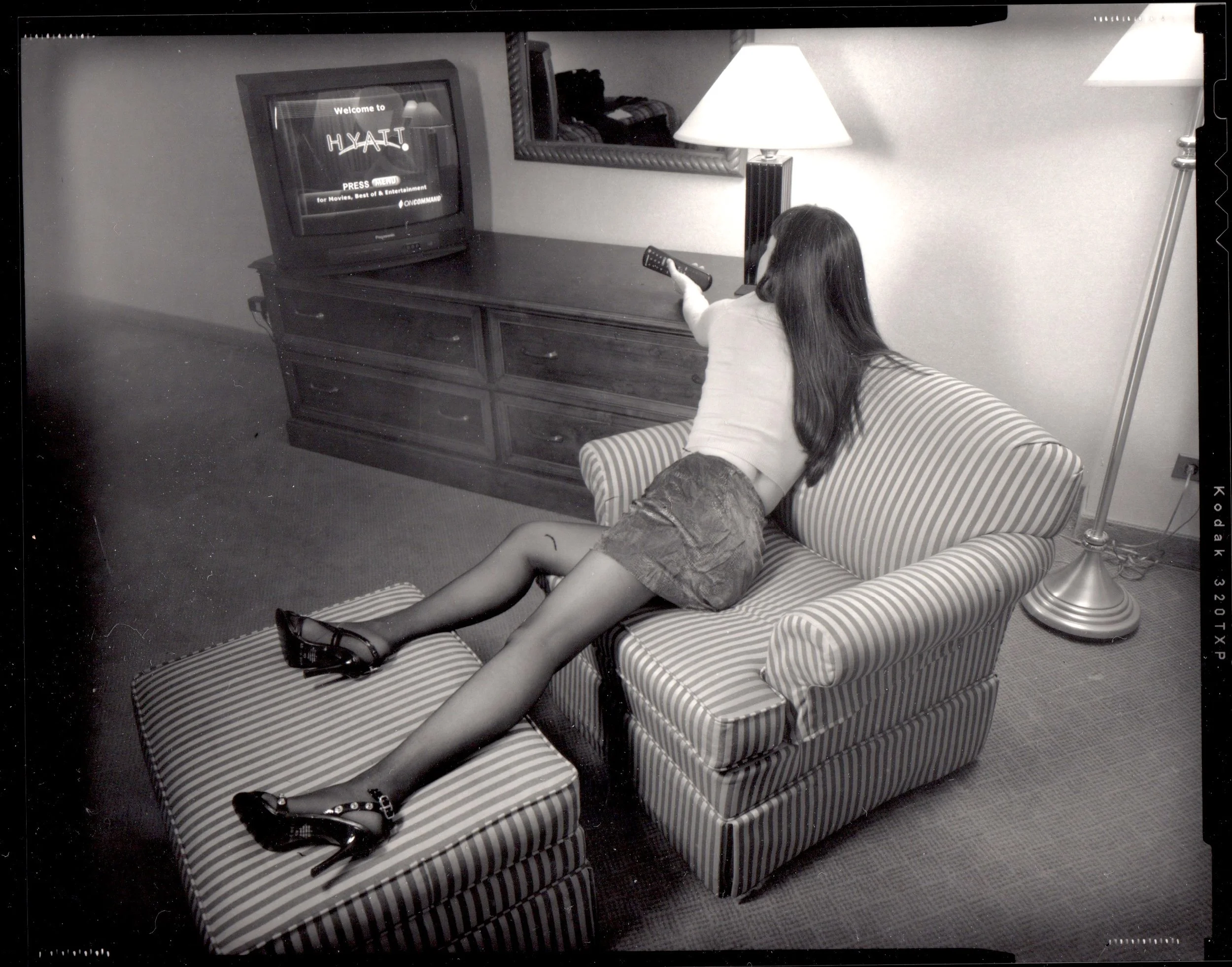
Hyatt Regency Arlington, Va. 4x5 Tachihara, 90mm f/8 Super-Angulon, Tri-X, 2004.